

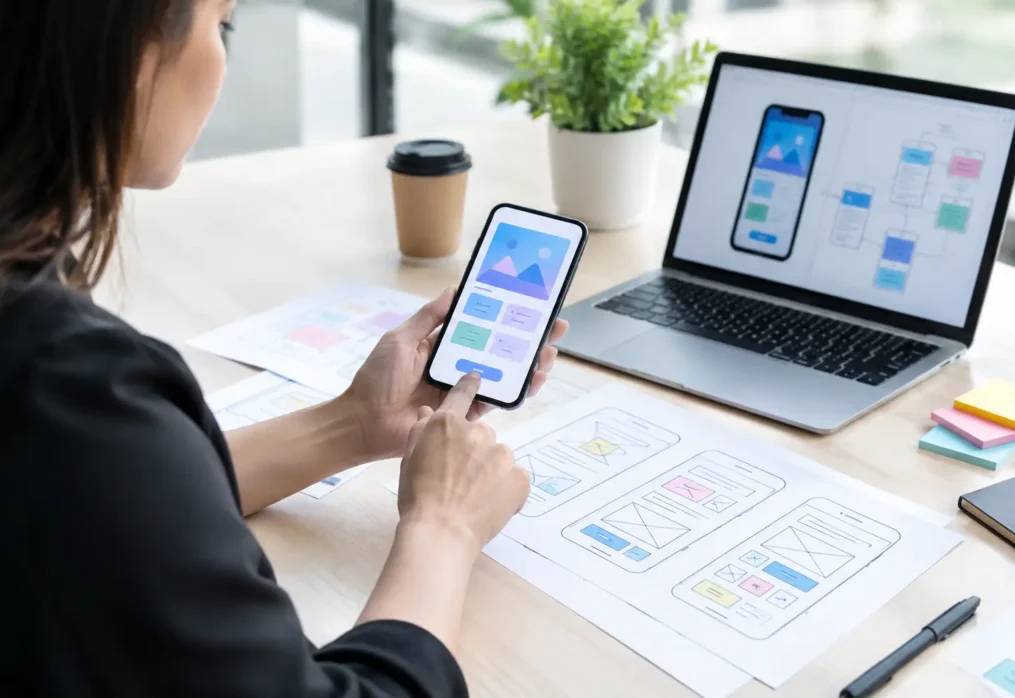

A mobile app can become a direct sales channel, a loyalty engine, a service tool, or a costly idea that customers never use. The difference is decided long before development begins. Knowing how to plan a mobile app means making smart commercial choices about the customer problem, the first version, the brand experience, and the results your business expects to achieve.
For founders and growing businesses, the goal is not simply to have an app in the app stores. The goal is to create a useful digital product that earns attention, supports operations, and gives customers another strong reason to choose your business.
Start With the Business Problem, Not the Features
The most expensive mistake in app planning is starting with a feature list. Businesses often begin with ideas such as push notifications, chat, loyalty points, online booking, or product recommendations. Each can be valuable, but none matters if the app does not solve a clear customer or business problem.
Start by defining what needs to improve. Perhaps customers abandon orders because mobile checkout is frustrating. Maybe your service team spends too much time answering routine questions. A retailer may need a better way to encourage repeat purchases, while a B2B company may want clients to access documents, requests, or account information without calling support.
A strong planning statement is specific: “We want to help repeat customers reorder their most-used products in under two minutes.” That statement gives your team a standard for every later decision. If a proposed feature does not help achieve it, it may not belong in the first release.
It also helps to identify the commercial outcome early. Your app could be designed to increase sales, increase retention, reduce administrative work, collect qualified leads, improve customer satisfaction, or create a paid digital service. One app can support several goals, but there should be one primary goal that guides the launch.
Define Who Will Use the App First
An app built for everyone usually feels generic to everyone. Before wireframes or visual design, identify the first audience you need to serve.
Think beyond broad labels such as “customers” or “small business owners.” Consider what the user is trying to do, when they need to do it, and what gets in their way. A busy parent ordering dinner has different expectations from a procurement manager approving an invoice. A first-time shopper needs confidence and clarity. A loyal customer wants speed and recognition.
Talk to actual customers whenever possible. Ask what they find difficult about your current website, ordering process, booking system, or service experience. Review customer emails, support requests, sales objections, and social media comments. These are often more useful than assumptions made in a meeting room.
You should also map the user journey. What happens immediately before someone opens the app? What is the one action they need to complete? What would make them return next week? Planning around real moments of need creates an app with purpose, not just polished screens.
How to Plan a Mobile App MVP
Your minimum viable product, or MVP, is the first version that delivers meaningful value without trying to do everything at once. It is not a low-quality app. It is a focused app.
For example, an e-commerce brand may launch with product browsing, secure checkout, order tracking, and personalized offers for existing customers. It may postpone advanced features such as virtual try-on, social shopping, or a large rewards program until customer behavior proves they are worth the investment.
The right MVP depends on your model. A booking business may need availability, payments, reminders, and account management. A field-service company may prioritize job updates, photo uploads, and internal communication. A membership brand may focus on exclusive content, renewals, and a simple member dashboard.
When deciding what makes the first release, evaluate every feature against three questions: Does it solve the core problem? Will customers understand why to use it? Can we measure whether it is working? If the answer is no, keep it in the future roadmap rather than forcing it into launch.
A focused MVP also gives your business room to learn. You can see where users drop off, what they use most, and which improvements are likely to create real returns. This is far more valuable than spending months building functions that look impressive but receive little engagement.
Choose the Right App Approach
A mobile app does not always need to be built the same way. Your choice should reflect the customer experience you need, your budget, your timeline, and how frequently people will use the app.
A native app is built specifically for iOS or Android. It can offer excellent performance and deeper access to phone capabilities such as camera functions, location, biometrics, and notifications. It is a strong option when the experience depends heavily on device features or when performance is central to the product.
Cross-platform development can create iOS and Android apps from a shared codebase. For many businesses, this provides a practical balance between quality, speed, and cost. It may be the right choice for customer portals, commerce apps, booking tools, and many service-based products.
In some cases, a mobile-first website or progressive web app is the smarter first move. If customers only need occasional access and your business is still testing demand, improving the mobile web experience may create greater value than asking customers to download another app. An honest strategy considers this trade-off instead of assuming an app is automatically the answer.
Build the Brand Experience Into the Plan
Customers judge your business through every digital interaction. An app that is confusing, inconsistent, or visually dated can weaken trust, even when the underlying service is good.
Your mobile app should feel like a natural extension of your brand. That means more than applying your logo and colors. The language, imagery, navigation, buttons, product presentation, and tone of support should all reflect how you want customers to see your company.
Clarity matters more than decoration. A customer should know where to tap, what will happen next, and how to complete a key task without effort. Strong design reduces hesitation, especially during checkout, booking, registration, or payment.
Accessibility should be part of this conversation from the beginning. Readable text, clear contrast, simple forms, descriptive labels, and logical navigation make the app more useful for more people. They also demonstrate the professionalism customers expect from a serious brand.
Plan the Technology Behind the Screens
The visible app is only one part of the project. Your plan needs to account for the systems that make it useful: payment processing, inventory data, booking software, customer relationship management tools, analytics, notifications, and user accounts.
List every platform the app needs to connect with. Then determine whether those systems have reliable integrations or APIs. A beautiful e-commerce app will create problems if it does not accurately reflect stock levels, pricing, customer accounts, or order status.
Security and privacy belong in the planning stage as well. If users create accounts, provide payment details, share location, or upload personal information, your team needs a clear approach to data handling, permissions, authentication, and access control. The exact requirements depend on your industry and app function, but trust should never be treated as an afterthought.
Set a Realistic Budget, Timeline, and Measurement Plan
App costs vary because app complexity varies. A simple internal tool is not the same investment as a consumer marketplace with payments, real-time updates, multiple user roles, and custom integrations. Be clear about what is included in the first phase, what is planned for later, and what ongoing costs will exist after launch.
Budget for more than development. You may also need discovery and strategy, UX design, brand assets, copywriting, app store preparation, testing, analytics, maintenance, and promotional activity. If nobody knows the app exists, even an excellent product will struggle to generate results.
Your measurement plan should begin before launch. Track metrics connected to the original business goal, such as downloads from qualified customers, registrations, completed bookings, conversion rate, repeat purchases, average order value, support tickets reduced, or customer retention. Avoid treating downloads alone as success. An app with fewer active, high-value users can outperform one with thousands of forgotten installs.
Launch With a Growth Plan, Not a Quiet Release
A successful launch gives customers a reason to download now. That might be early access, exclusive offers, easier reordering, a faster booking process, member-only content, or a new level of service convenience.
Promote the app across the places where your audience already pays attention: your website, email campaigns, social media, in-store materials, sales conversations, and post-purchase communications. Your launch message should focus on the customer benefit, not technical features. “Track your order in real time” is stronger than “Our new app has account functionality.”
After launch, keep listening. Review analytics, customer feedback, ratings, and support questions. The best mobile apps improve through informed iteration, not one large release followed by silence.
A well-planned app gives your business more control over the customer relationship and more opportunities to convert engagement into revenue. If you need a partner to connect strategy, brand, development, and promotion, RDM Media can help turn a promising app idea into a professional digital asset built for growth.