

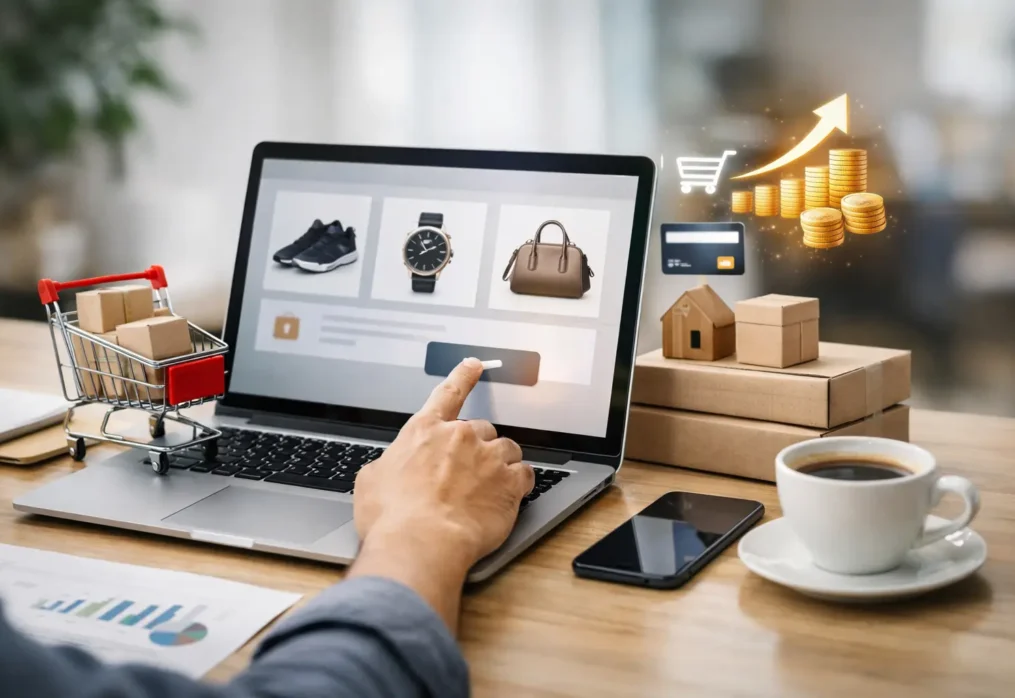

A customer finds your product on Instagram, clicks through to your store, and hesitates for just a few seconds. Can they immediately understand what you sell, why it is worth buying, and how to check out? That moment is where ecommerce development earns its value. A store is not simply an online catalog. It is a sales environment where brand presentation, customer confidence, technology, and marketing must work together.
For growing businesses, a poorly planned store can waste the attention created by great content, paid campaigns, and word of mouth. A well-built one gives that attention somewhere productive to go: toward inquiries, purchases, repeat orders, and stronger customer relationships.
Ecommerce Development Starts With the Business Goal
The first question should not be, “Which platform should we use?” It should be, “What must this store achieve?” A local retailer expanding beyond its neighborhood has different needs than a B2B supplier accepting repeat wholesale orders. A founder selling a focused product line has different priorities than a brand managing hundreds of variations, subscriptions, or international shipping rules.
Clear commercial goals shape every decision that follows. If the goal is direct-to-consumer growth, the store may need persuasive product pages, fast checkout, email capture, and social commerce integration. If the goal is generating qualified B2B leads, pricing access, quote requests, account areas, and product specifications may matter more than a traditional cart.
Strong development turns business requirements into a practical customer journey. It does not force a business into features it will never use. More functionality can create more cost, maintenance, and confusion. The best approach is purposeful: build what supports sales now, while leaving room for the next stage of growth.
Build Trust Before Asking for the Sale
Customers cannot touch a product online. They use visible signals to decide whether a business is credible enough to buy from. That makes design more than decoration. It is a direct part of conversion.
Your storefront should carry a consistent identity from the first landing page through checkout. Product imagery should be clear and useful. Copy should answer the questions customers ask before they ask them: What is this? Who is it for? What makes it different? When will it arrive? What happens if there is a problem?
Trust also depends on the details many businesses overlook. Accurate inventory status, easy-to-find contact information, transparent shipping and return policies, secure payment options, and real customer reviews reduce hesitation. For higher-value products or unfamiliar brands, these details can make the difference between an abandoned cart and a completed order.
A premium visual style can help position a business, but it cannot compensate for unclear navigation or vague product information. Customers should not have to work to find sizes, compare options, or understand pricing. The most effective stores make the buying decision feel straightforward and well supported.
Product Pages Do the Heavy Lifting
A product page is often where marketing interest becomes revenue. It should combine strong visuals with practical buying information. Include product benefits before technical details, while still making specifications easy to locate for customers who need them.
For products with multiple variants, the selection process needs special attention. Color, size, material, bundle options, and personalization should be easy to choose without creating uncertainty. If an item has a longer delivery window or requires custom production, say so clearly. Setting the right expectation protects your reputation after the sale.
Choose Technology That Fits Your Operation
There is no single perfect ecommerce platform. The right choice depends on your catalog, budget, internal resources, integration needs, and growth plans. A simpler hosted platform can be a smart choice for a business that wants speed, predictable management, and fewer technical demands. A more customizable solution may suit companies with advanced inventory workflows, unique pricing rules, or complex integrations.
The trade-off is usually control versus simplicity. Custom features can create a differentiated shopping experience, but they require thoughtful planning and ongoing support. A low-maintenance platform can get a brand selling quickly, but it may impose limitations as the business expands. The goal is not to select the most expensive or technically impressive option. It is to select technology your team can use confidently while meeting customer expectations.
Development should also consider the systems behind the storefront. Payment processing, shipping tools, inventory management, customer relationship management software, analytics, accounting, and email marketing all affect day-to-day operations. When these systems are disconnected, staff often spend hours correcting orders or moving data manually. When they are planned together, the store becomes easier to manage and more reliable for customers.
Make Mobile the Primary Experience
For many brands, mobile is where customers first encounter products, compare prices, and return when they are ready to buy. A desktop-first store that merely shrinks onto a phone is not enough. Buttons must be easy to tap, text must be readable, images must load quickly, and checkout must ask for only the information that is truly necessary.
Mobile performance affects both sales and marketing efficiency. If a social campaign sends visitors to a slow, confusing landing page, the cost of acquiring each visitor rises while the chance of conversion falls. The same is true when shoppers must create an account before buying or search through several screens to find delivery details.
Test the store as a customer would. Open it on different devices. Search for a product. Add it to the cart. Apply a discount. Check shipping costs. Complete a purchase. Small points of friction become visible quickly when you follow the entire path instead of reviewing isolated pages.
Connect Ecommerce Development to Marketing
A store should not be built in isolation and handed to the marketing team afterward. Ecommerce development and customer acquisition need to support each other from the start. Campaign landing pages, social content, search visibility, email offers, and retargeting all work better when the store has clear categories, focused messaging, and useful data tracking.
For example, a campaign promoting a seasonal collection should lead customers directly to that collection, not to a generic homepage. A popular Instagram post can inspire a product landing page built around the questions, visuals, and benefits that drove engagement. An email campaign for previous customers should recognize what they bought and offer a relevant next step.
Measurement matters here. Track which channels bring visitors, which pages encourage product views, where customers leave, and which products create repeat purchases. Numbers alone do not tell the whole story, but they help businesses make better decisions. A low conversion rate may signal weak traffic quality, unclear value, unexpected shipping costs, or checkout issues. The answer depends on the evidence, not guesswork.
Plan for Growth and Ongoing Improvement
Launching an ecommerce store is the beginning of a commercial system, not the finish line. Products change, customers ask new questions, promotions evolve, and technology requires regular attention. The businesses that get the most from their stores review performance and improve the customer experience over time.
That may mean refining product descriptions, adding better imagery, simplifying navigation, improving site speed, or creating bundles based on buying behavior. It can also mean preparing for expansion into new regions, adding wholesale access, or connecting a loyalty program. The right priorities depend on what is holding back the next stage of revenue.
RDM Media approaches ecommerce as part of a larger digital presence: the store, the brand, the creative work, and the marketing strategy should reinforce one another. When they do, your business looks more professional, earns more confidence, and has a stronger foundation for growth.
Your customers are already making fast decisions online. Give them a store that makes choosing your business feel like the obvious next step.