

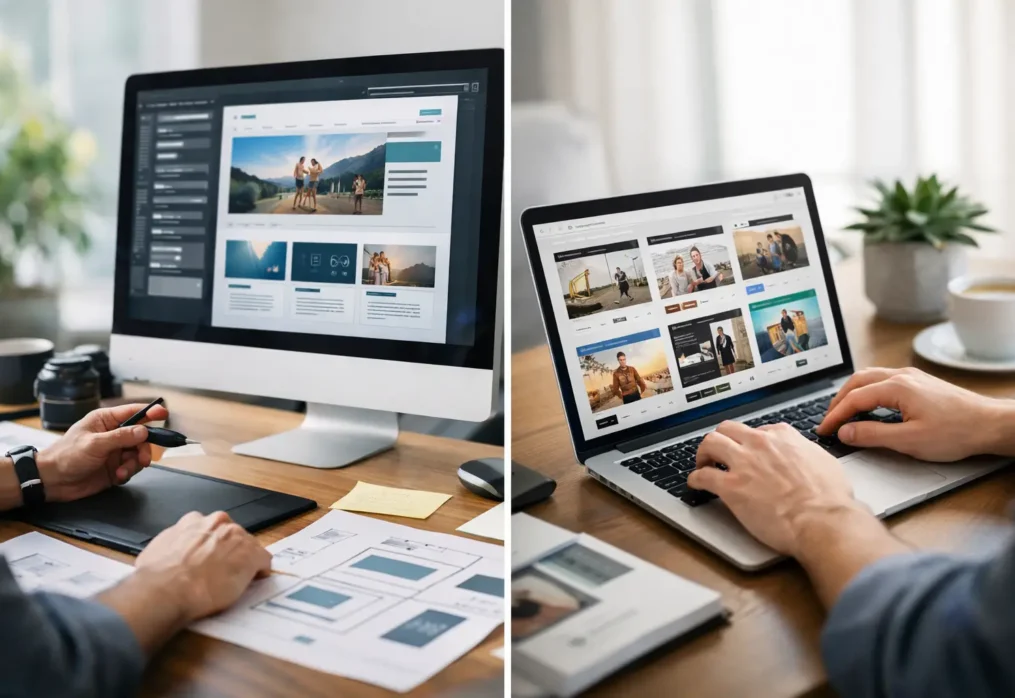

A website can either make a prospect feel confident enough to contact you or give them one more reason to keep searching. That is the real business question behind custom website vs template. The decision is not simply about design preferences or what looks good on launch day. It affects how clearly you present your value, how easily customers take action, and how far your digital presence can grow with the business.
Templates can be a smart starting point. A custom website can become a stronger long-term sales asset. The right answer depends on where your business is now, what customers expect from you, and what you need your website to achieve next.
Custom Website vs Template: The Core Difference
A template website uses a pre-built layout that has been designed for broad use. You select a style, add your logo, replace placeholder text, choose colors, and publish. Modern website builders and e-commerce platforms make this process accessible, which is why templates are popular with new businesses and founders who need an online presence quickly.
A custom website is planned and designed around your specific brand, customer journey, services, products, and commercial goals. Instead of fitting your business into an existing layout, the layout is built to support how your business sells, communicates, and operates.
That distinction matters when a visitor lands on your site. A template may provide the basic pages you need. A custom site can guide visitors from awareness to trust to action with deliberate messaging, page structure, visual hierarchy, calls to action, and functionality.
When a Template Website Makes Business Sense
A template is not a poor choice by default. For an early-stage business, a local service provider testing a new offer, or a founder who needs a simple online brochure fast, it can be a practical way to get visible without a major upfront investment.
Templates are usually faster to launch because the core structure already exists. They also provide a clear framework for businesses that have limited content, a tight budget, or a straightforward need such as displaying services, business hours, contact details, and a small product catalog.
A template may be the right fit if your immediate goal is to establish credibility, validate a business concept, or create a temporary foundation while you build your brand. The key is to treat it as a strategic starting point, not automatically as a permanent solution.
The challenge begins when a business tries to force a growing operation into a layout that was never built for it. Extra pages become hard to organize. Important service information gets buried. Product filtering feels limited. Every requested change becomes a workaround. At that point, the website can start slowing down growth instead of supporting it.
Where Templates Can Hold You Back
The biggest limitation of a template is not that other businesses may use the same one. Most customers will not recognize the exact layout. The bigger issue is that generic structure often produces generic communication.
Your business may have a detailed sales process, several customer types, complex services, regional locations, unique proof points, or a strong social media audience that needs a tailored path to purchase. A standard template may not have room to make those details clear without becoming cluttered.
Brand differentiation is another concern. If your visual identity, photography, messaging, and page flow all feel familiar, visitors may assume your offer is familiar too. In competitive categories, that can make it harder to justify your pricing or earn trust before the first conversation.
Performance can also become an issue. Templates often include features, scripts, and design elements that your business does not need. Too many plugins, heavy visual effects, and poorly managed additions can affect load times and make maintenance more difficult. A template can still perform well, but it requires thoughtful setup rather than simply installing a theme and filling in the blanks.
Why a Custom Website Creates More Commercial Value
A custom website begins with business strategy. Before visual design, the important questions are clear: Who needs to visit the site? What objections do they have? What information helps them decide? What action should they take? How will the site support leads, sales, bookings, quote requests, or customer retention?
Those answers shape the experience. A B2B company may need industry-specific service pages, case studies, trust signals, and a lead qualification form. An e-commerce brand may need product discovery tools, bundles, subscription options, promotional landing pages, and a checkout process that reduces friction. A local business may need location pages, appointment requests, reviews, and direct mobile contact options.
Custom design also gives your brand more room to lead. Your typography, color system, imagery, motion, and content can work together to create a professional impression that feels distinctly yours. That matters because customers often judge capability before they understand your full offering. A polished, purposeful website signals that the business behind it is prepared, credible, and serious about customer experience.
A custom build is especially valuable when your website needs to connect with broader marketing activity. If you are investing in paid campaigns, social media growth, search visibility, email marketing, or reputation management, your website needs to convert the attention those channels create. Sending an interested visitor to a generic page with unclear next steps wastes momentum.
Cost, Speed, and Return on Investment
Cost is usually the first factor business owners consider, and it should be. Templates generally cost less upfront and can launch faster. Custom websites require more planning, content development, design, development, testing, and refinement. That investment is justified when the website has a meaningful role in generating revenue or supporting operations.
The better question is not, “Which option is cheapest?” It is, “What will a weak website cost us?” If unclear navigation causes leads to leave, if a poor product experience lowers sales, or if your site does not reflect the quality of your work, the low initial price can become expensive over time.
A custom website should not be treated as an artistic expense. It should be evaluated as a business asset. Its return may come through higher-quality inquiries, stronger conversion rates, larger average orders, easier sales conversations, better campaign performance, and a more credible market position.
Still, custom is not always necessary on day one. A growing business can make a smart staged decision: launch a well-organized template now, establish the brand and demand, then invest in a custom experience when the business has clearer needs and higher traffic. What matters is choosing intentionally rather than settling for a platform that limits your next move.
SEO and Scalability: Build for the Next Stage
Search visibility depends on many factors, including useful content, site structure, technical setup, page speed, and the relevance of your pages to what customers are searching for. Both template and custom websites can be optimized for SEO. A custom website does not automatically rank higher, and a template does not automatically rank poorly.
The advantage of custom development is control. You can create a logical page architecture for services, industries, locations, product categories, and resource content without relying on awkward workarounds. You can also prioritize performance, clean conversion paths, structured content, and the integrations your team actually needs.
Scalability matters in the same way. If you expect to add products, locations, user tools, booking flows, member areas, or campaign landing pages, consider that future before choosing a platform and design approach. Rebuilding is sometimes necessary, but it is far more efficient when growth has been anticipated early.
How to Choose the Right Website for Your Business
Choose a template when speed, simplicity, and budget are the priority, and your business needs a clear but basic web presence. Choose custom when your website is central to lead generation, e-commerce, brand positioning, or a more complex customer journey.
Ask yourself whether your current site reflects the quality of your business, whether it makes it easy for customers to understand your offer, and whether it can support the marketing you plan to do over the next 12 to 24 months. If the answer is no, a more strategic build may be the stronger investment.
At RDM Media, we help businesses turn websites into growth-focused digital foundations, not just online placeholders. Whether you need a strong first launch or a custom platform built for the next stage, start with the customer experience you want to create – then build a website that gives your business the confidence to grow.